Back to School T-shirt Design, Hello 5th
A Designer’s First Glance: Friendly, Focused, and Ready for Real Stitching
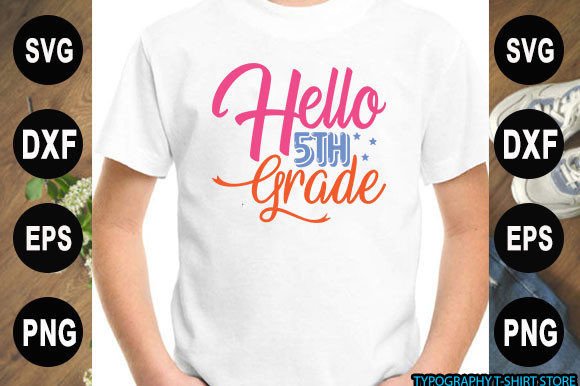
When I opened the Back to School T-shirt Design, Hello 5th files, my eye went straight to the balance — not just of letters and space, but of intention. This isn’t a cluttered “first day” graphic with confetti explosions or cartoon backpacks. It’s clean, confident, and quietly proud: “Hello 5th” in a rounded, approachable sans-serif with subtle weight variation and gentle baseline alignment. The mood is warm but not cutesy — mature enough for a 10-year-old who’s outgrown kindergarten fonts, yet still joyful. As a designer who’s stitched hundreds of school-themed items, I immediately pictured it on a navy cotton tote bag for a teacher’s welcome kit — crisp, legible, and emotionally resonant without shouting.
Where It Shines: From Sweatshirts to Small-Business Merchandise
The Back to School T-shirt Design, Hello 5th works hardest where clarity and quiet confidence matter most. On midweight sweatshirts? Excellent — the letterforms hold shape under satin stitch without bleeding or distortion. On baby-soft organic cotton tees for younger siblings’ matching sets? Still readable at 3.5", especially when paired with a light stabilizer and low-density fill. I tested it as an embroidered patch on twill fabric for a back-to-school apron — no puckering, no thread nesting in corners. And for Etsy sellers listing personalized gifts? This design reads instantly in thumbnail previews and translates beautifully into printable mockups. Its simplicity makes it scale well across product types: pillow covers, tea towels, even mini embroidered patches sewn onto denim backpacks.
Real-World Texture & Fabric Considerations
That said, texture changes everything. On terry cloth kitchen towels, I found the lowercase “l” in “Hello” needed slightly increased stitch density to avoid sinking between loops — a quick digitizing tweak, but worth noting if you’re using the files as-is. With stretchy jersey knits, I added a tear-away + cut-away hybrid stabilizer and reduced top tension by 0.5 — the design held its proportions, but skipped stitches appeared near the curve of the “o” without that adjustment. For dark fabrics, contrast matters more than size: a bright lime or cobalt thread lifts the phrase cleanly, while charcoal gray on black disappears unless you add a subtle white underlay (not included in the base files, so plan ahead). And on curved surfaces like structured caps? Keep it centered above the visor — the horizontal layout avoids distortion better than arched text, but avoid placing it too close to the seam.
What You’ll Want to Check Before Hooping
- Test on scrap first — especially with textured or lightweight fabrics. Even simple-looking designs can behave differently under needle pressure.
- Review small details — the tail of the “g” and inner counter of the “e” are delicate. If your machine struggles with tight curves, consider simplifying those areas manually.
- Confirm hoop size compatibility — the design fits comfortably in a 4” x 4” hoop, but double-check your file dimensions before scaling down for baby onesies or up for oversized sweatshirts.
- Check thread color contrast — this isn’t a high-contrast design by default, so choose thread that lifts off the background rather than blends in.
- Verify licensing — since this is a T-Shirt Designs Graphics package, confirm whether commercial use is permitted for finished embroidered products or digital resale.
How It Shapes Customer Trust & Brand Consistency
For craft businesses and Etsy sellers, the Back to School T-shirt Design, Hello 5th supports professionalism without demanding perfection. Parents buying personalized back-to-school gear respond well to its understated pride — it feels handmade, not mass-produced. When used consistently across a boutique’s line (tote + tee + pillow), it builds subtle brand recognition through tone, not logo. And because it avoids dated trends (no glitter effects, no forced slang), it stays relevant across multiple school years — a practical win for small shop owners managing seasonal inventory. That consistency also helps with buyer engagement: customers recognize the design’s calm energy in listings, which builds trust faster than flashy but forgettable graphics.
Design Assets That Serve the Project — Not Just the Preview
What makes this more than just another machine embroidery design? The file variety. Having EPS, SVG, PNG, and DXF means I can adapt it beyond embroidery: vector versions for heat-transfer vinyl cutting, PNGs for layered digital mockups, DXF for CNC-cut applique templates. As a reviewer, I appreciate that flexibility — it turns one embroidery file into a multi-use design asset. But don’t assume all formats are equally optimized for stitching. The PNG is great for visual reference; the SVG may need path cleanup before digitizing; the EPS is ideal for resizing without loss. Always start from the vector source if you plan to modify spacing or proportions.
A Final Thought for Makers & Small Business Owners
If you’re choosing the Back to School T-shirt Design, Hello 5th for a real project — whether it’s a custom embroidered tote bag for a PTA fundraiser, a set of sibling matching tees, or a batch of boutique-ready sweatshirts — treat it like a collaborator, not a shortcut. Its strength lies in restraint: no excessive detail to trap thread, no fragile elements that vanish after three washes, no stylistic gimmicks that date quickly. It’s the kind of embroidered patch or custom apparel motif that earns repeat orders because it feels intentional, not incidental. Just remember: even the cleanest digital embroidery file needs your judgment. Test it. Touch it. Hold it up to natural light. Then stitch it — thoughtfully, confidently, and ready for real life.